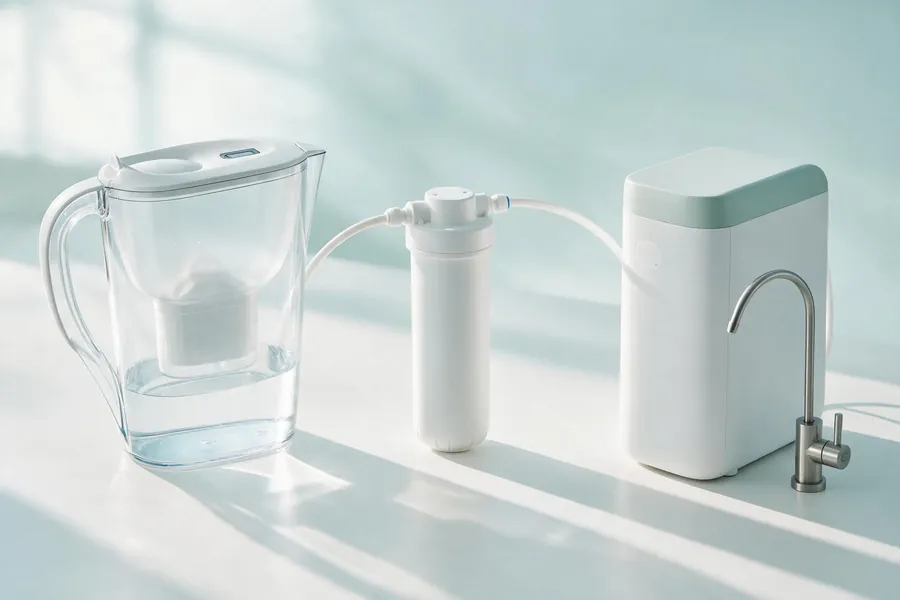

Three designs, three price ranges, three results. The comparison by purchase price, running costs, effect and effort, so that you do not buy the wrong filter.
In short
- Jug filter: cheap, portable, good against limescale and taste, but needs monthly cartridges.
- Under-sink filter: fast, invisible, good against taste and particles, medium cost.
- Reverse osmosis system: most thorough purification, highest price, waste water and maintenance.
- With old pipes and wells, reverse osmosis is the only safe choice.
The three designs at a glance
| Criterion | Jug filter | Under-sink filter | Reverse osmosis system |
|---|---|---|---|
| Purchase price | 20 to 50 euros | 100 to 400 euros | 200 to 1,200 euros |
| Running costs per year | 60 to 100 euros | 60 to 150 euros | 80 to 250 euros |
| Cost per litre | about 15 to 25 cents | about 5 to 10 cents | about 5 to 15 cents |
| Limescale | less | depends on the cartridge | almost completely gone |
| Taste, chlorine | good | very good | very good, but “empty” |
| Nitrate, lead, medicines | hardly any effect | partly | 90 to 99 per cent |
| Minerals | fewer | remain | gone, can be remineralised |
| Effort | cartridge monthly | cartridge every six months | filters every six months, membrane every 2 to 3 years |
| Installation | none | plumber, or yourself if you are handy | plumber recommended |
When a jug filter is enough
If your water is hard and you mainly want less limescale in the kettle and coffee machine, or if you rent and are not allowed to connect anything. The jug filter is no protection against pollutants, but it is a good taste improver.
When an under-sink filter is better
If your household drinks several litres a day, you do not fancy cartridges in the fridge and you want the water straight from the tap to be fresh. With an activated carbon block and a fine filter, it is usually the best compromise between price and effect for mains water.
When only reverse osmosis helps
With lead pipes in an old building, a private well with nitrate, very hard water that is still a nuisance despite a softener, or if you want water with defined values for an aquarium, espresso or baby food. The Reverse osmosis calculator shows when the purchase pays off compared with bottled water.
Try it out
Reverse osmosis calculatorSystem, filters and wastewater against bottled water: cost per litre and payback in months.Hardness converterConvert °dH, °fH, °e, mmol/l and ppm into one another and read off the hardness range and descaling interval.Frequently asked questions
Do I need a plumber for an under-sink filter?
Not if you are reasonably handy: close the angle valve, fit the T-piece, connect the filter, mount the tap. If you are unsure, have it done; it takes an hour.
Do I lose important minerals with reverse osmosis?
In the water yes, in your diet hardly. Most minerals come from food. If you like, add remineralisation afterwards.
Share