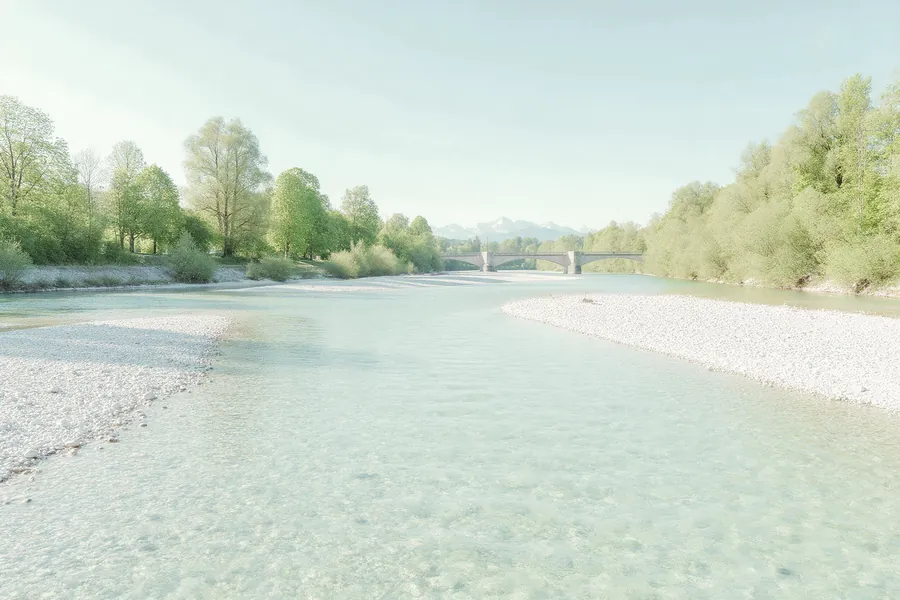
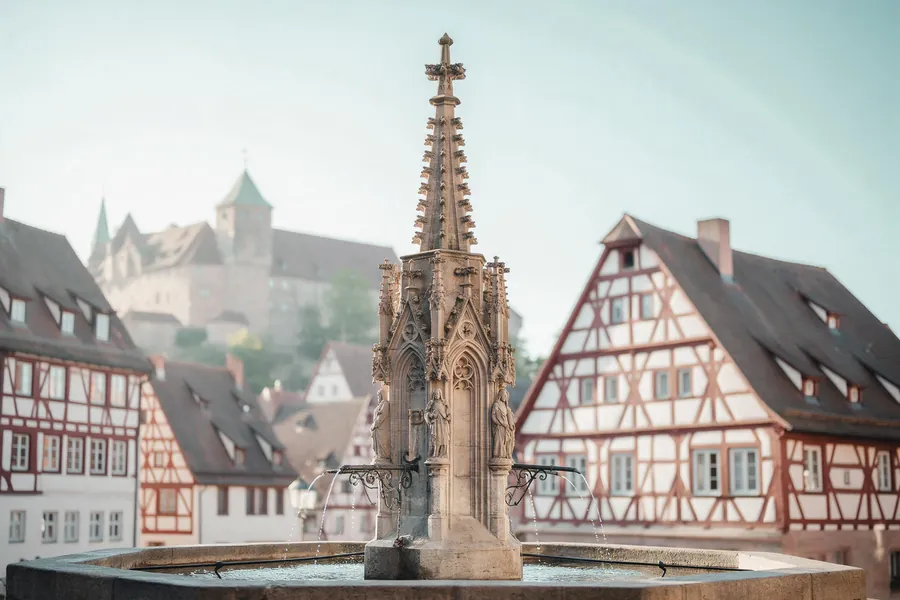

Nuremberg draws its water from the Ranna valley in Franconian Switzerland (Fränkische Schweiz) and from groundwater works in the Reichswald. It is hard to medium-hard, well treated and distributed without chlorine.
Water hardness
15.0 °dHhardA lot of calcium and magnesium: good for the body, a nuisance for appliances. Descale regularly and use more detergent. Descale: every 4 weeks.
Aquaviana’s advice
- Hardness is 12 to 18 °dH, somewhat higher in the Ranna valley water.
- Descale every four to six weeks.
- Nuremberg’s waterworks protect large areas of forest in the Reichswald as a catchment area.
Where the water comes from
Around 40 per cent of Nuremberg’s water comes from the Ranna waterworks in Franconian Switzerland, where karst water and groundwater from the Jurassic limestone are extracted and piped 60 kilometres into the city. The rest comes from the Genderthal, Krämersweiher and Erlenstegen works in the Nuremberg Reichswald. The water is aerated, filtered and, as a precaution, disinfected with UV light.
Hardness and taste
Ranna water from limestone is hard, Reichswald water from sandstone medium. The network supplies 12 to 18 °dH, 15 on average (about 270 mg/l CaCO3). It tastes full and mineral, with calcium around 80 to 100 mg/l and nitrate 10 to 20 mg/l.
What that means day to day
Typically Franconian hard: descale, and set the washing machine to “hard”. A plus for your health, a filter for your tea. N-ERGIE publishes hardness and analysis by district. Lead pipes are rare in Nuremberg’s older buildings, because the city switched early to iron and copper.
Try it out
Hardness converterConvert °dH, °fH, °e, mmol/l and ppm into one another and read off the hardness range and descaling interval.Tap water checkEight questions about your home, pipes and region, an assessment with a traffic light and next steps.Share