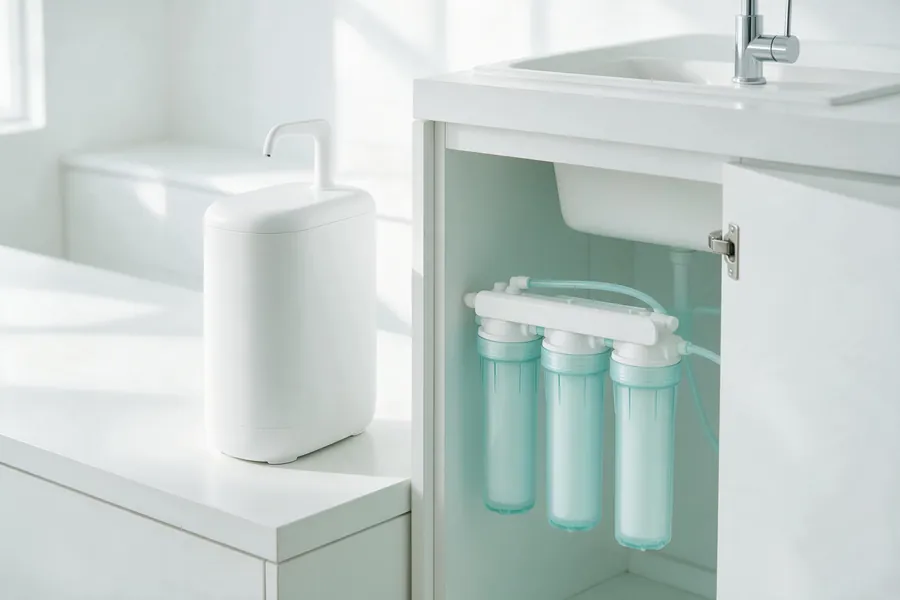

Three designs for three kitchens: the classic tank system in the cupboard, the countertop unit with no installation and the direct-flow system with no tank. Pros and cons, space, price.
In short
- Under-sink with tank: inexpensive, proven, needs space and maintenance, and the water stands in the tank.
- Countertop: no installation, ideal for renting and offices, has to be filled by hand.
- Direct flow: no tank, instantly fresh water, little waste water, higher price.
- Direct flow for families, countertop for singles and renters, tank for bargain hunters.
Under-sink system with tank
The classic design: filters and membrane in the kitchen cupboard, a pressure tank of 8 to 12 litres, and a separate tap or three-way tap at the sink. The water is produced slowly (about 8 to 15 litres per hour) and stored in the tank. Advantages: inexpensive from 200 euros, robust, no electricity. Disadvantages: the tank needs space, the water sometimes stands in it for hours, the waste water ratio of 1:3 to 1:4 is poor, and the tank bladder has to be checked every few years.
Countertop unit
A device on the worktop with its own supply container, which you fill by hand with tap water. It filters into the pure water container, and the concentrate stays in the device or is poured away. Advantages: no installation, portable, ideal for a rented flat, an office or a motorhome, from 300 euros. Disadvantages: manual filling, limited quantity (2 to 5 litres per fill), takes up worktop space, needs electricity.
Direct-flow system
An under-sink system without a tank, with a pump and a large membrane that delivers 1 to 2 litres per minute directly. Advantages: always fresh water, no tank, little space needed, a waste water ratio of 1:1 or better, more hygienic. Disadvantages: 500 to 1,200 euros, needs electricity, and the pump is faintly audible.
Comparison
| Criterion | Tank | Countertop | Direct flow |
|---|---|---|---|
| Price | 200 to 500 euros | 300 to 600 euros | 500 to 1,200 euros |
| Installation | yes, under the sink | none | yes, under the sink |
| Output | 8 to 15 l/h into the tank | 1 to 2 l per fill in 10 min. | 1 to 2 l/min directly |
| Waste water | 1:3 to 1:4 | 1:1 to 1:3 | 1:1 or better |
| Electricity | no | yes | yes |
| Hygiene | flush the tank | clean the container | best |
| Suited to | Bargain hunters, owners | Renters, offices, camping | Families, heavy drinkers |
The tap
A separate reverse osmosis tap is the simplest. More elegant is a three-way tap that delivers cold, hot and pure water from one spout, with separate lines inside. It costs 150 to 400 euros and replaces the existing tap. If you are interested in a system, you can request an assessment for your own kitchen via the advice form.
Frequently asked questions
How loud is a system with a pump?
About as loud as a fridge starting up, and only while drawing water. Barely noticeable in the cupboard.
Can I convert a tank system to direct flow later?
Only with a new membrane, pump and controller, which is rarely worth it. Next time you buy, choose direct flow straight away.
Share