
Three ways to check your water: test strips for 10 euros, a TDS meter for 15 and a lab test from 30. What each method shows, where it misleads and when each makes sense.
In short
- Test strips: hardness, pH, nitrate and chlorine in rough colour steps, for a first impression.
- TDS meter: the sum of dissolved substances, says nothing about pollutants, good for checking a filter.
- Lab: the only method for lead, copper, germs and pesticides, from 30 to 150 euros.
- Take the sample properly: a stagnation sample in the morning and a sample after running the water for two minutes.
Test strips
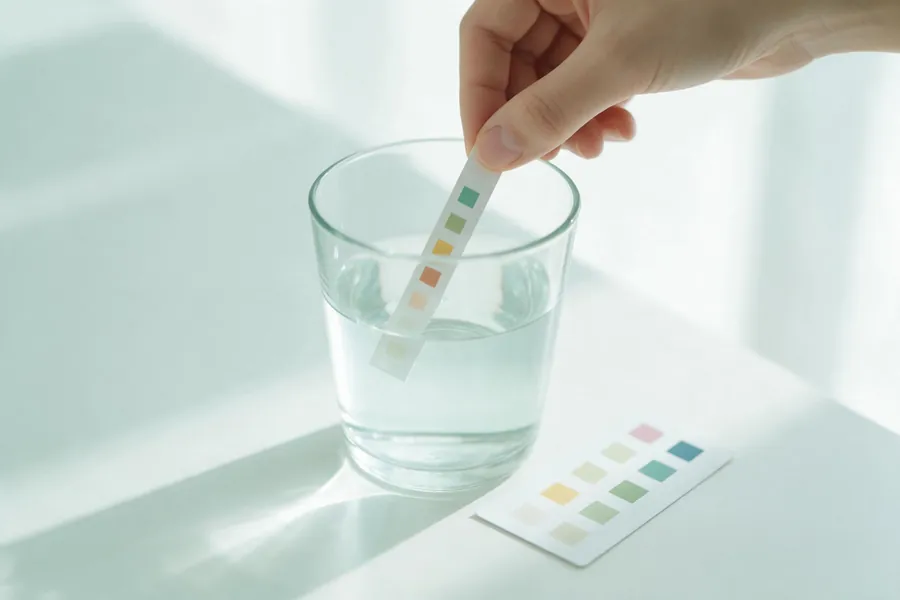
Strips with coloured pads that you dip briefly into the water and compare with a scale. Typical pads: total hardness, carbonate hardness, pH, nitrate, nitrite, chlorine, sometimes iron and copper. They cost 8 to 20 euros for 50 to 100 strips. Advantage: an instant result, ideal for hardness and pH. Disadvantage: coarse steps (nitrate, for example, 0, 10, 25, 50, 100 mg/l), colour comparison by eye, no heavy metals, no germs. Good for determining water hardness for the washing machine and for coffee, and for roughly estimating nitrate in a well.
TDS meter
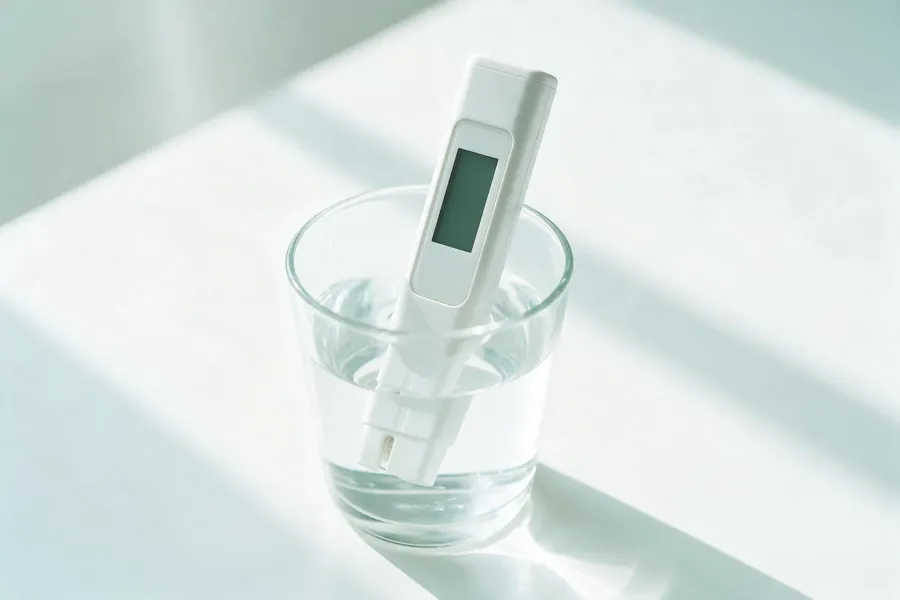
A pen with two electrodes that measures electrical conductivity and converts it into “total dissolved solids” in ppm (mg/l). It costs 10 to 25 euros. Tap water shows 150 to 600, reverse osmosis water 5 to 30, mineral water 50 to 2,000. The device is perfect for checking whether a reverse osmosis membrane is still working and for a rough classification of water. But it cannot tell healthy calcium from toxic lead: both are simply conductivity. A low TDS value does not mean clean, and a high one does not mean dirty. What the value really tells you is explained in the article Understanding TDS.
Lab test
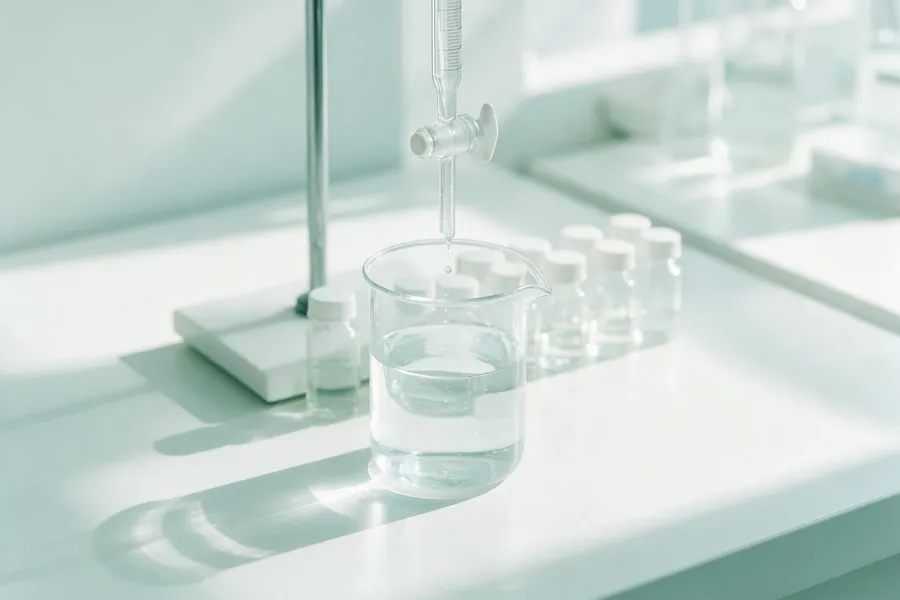
You order a kit, fill the sample bottles according to the instructions and send them in. After one to two weeks a report arrives with the measured values and a comparison with the limit values. Prices: heavy metals (lead, copper, nickel, zinc) from 30 to 60 euros, microbiological (E. coli, enterococci, Legionella) from 40 to 80, a complete package with nitrate, pesticides and minerals 100 to 200. Only this gives you reliable figures for lead from old pipes, germs in a well or pesticides. Look for an accredited laboratory.
Taking the sample properly
- Stagnation sample: in the morning, before any water has been used anywhere in the house, catch the very first flow. It shows what the pipes and fittings released overnight.
- Flushed sample: after running the water for two minutes. It shows the water as it arrives from the supplier.
- No aerator, no filter, no hot water. Do not touch the inside of the bottles, close them immediately, store them in a cool place and send them in quickly.
If the two samples differ greatly, the problem is in the house, see Old pipes.
Which method when
| Question | Method |
|---|---|
| How hard is my water? | Test strips or your supplier |
| Is my reverse osmosis system working? | TDS meter |
| Older building, lead or copper? | Lab, heavy metals |
| Private well | Lab, germs plus nitrate, every year |
| Water tastes odd | Ask the supplier first, then a lab |
| Baby food | Lab, lead, nitrate, uranium |
If you first want to know whether a test is needed at all, do the Tap water check: eight questions, one assessment.
Try it out
Tap water checkEight questions about your home, pipes and region, an assessment with a traffic light and next steps.Hardness converterConvert °dH, °fH, °e, mmol/l and ppm into one another and read off the hardness range and descaling interval.Frequently asked questions
What does an analysis by the health authority cost?
Health authorities (Gesundheitsämter) do not test for private individuals, but they will point you to accredited labs and, if you suspect lead, give you information about the building.
How often should I test?
Public mains water: only if you suspect a problem or have old pipes, and then once. Private wells: germs and nitrate every year, the full package every three years.
Share