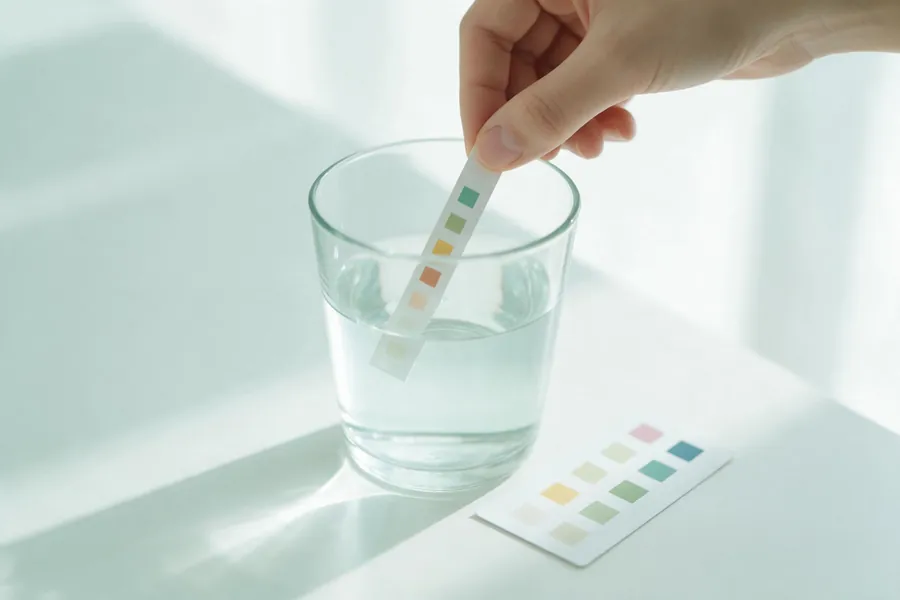
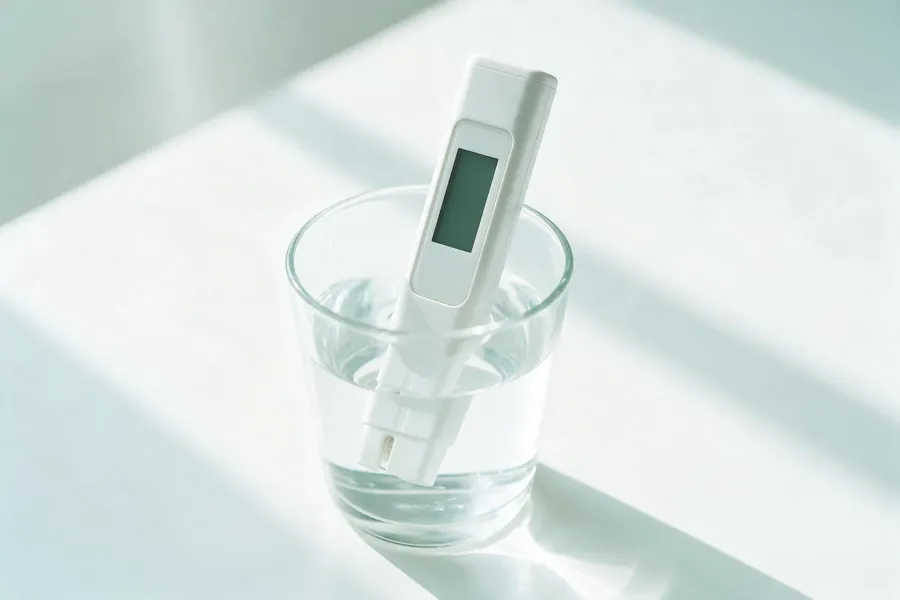

TDS meters are cheap and popular, and their number is constantly misread. What ppm means, why 300 is not dirty and 10 is not pure, and how to use the meter sensibly.
In short
- TDS measures conductivity and converts it into dissolved substances, in ppm or mg/l.
- Tap water 150 to 600, mineral water 50 to 2,000, reverse osmosis water 5 to 30.
- The value does not distinguish between calcium and lead; it shows quantity, not kind.
- Useful for checking filters and for comparisons, not for health verdicts.
What the device measures
A TDS pen measures how well water conducts electricity. Dissolved ions such as calcium, magnesium, sodium, hydrogen carbonate, chloride and sulphate conduct, while pure water practically does not. The device multiplies the conductivity by a factor (usually 0.5 to 0.7) and displays “total dissolved solids” in ppm, that is, milligrams per litre. The value is an approximation of the total mineralisation, not a measurement of individual substances.
Typical values
| Water | TDS in ppm |
|---|---|
| Distilled water | 0 to 5 |
| Reverse osmosis water | 5 to 30 |
| Soft tap water (reservoir) | 50 to 150 |
| Medium tap water | 150 to 350 |
| Hard tap water | 350 to 700 |
| Light mineral water | 50 to 300 |
| Strongly mineralised mineral water | 1,000 to 2,500 |
| Seawater | around 35,000 |
What the value cannot do
It does not distinguish between healthy calcium and toxic lead, because both conduct. It does not see bacteria, pesticides, microplastics or PFAS, because these conduct little or not at all. Water with 400 ppm can be an excellent calcium-rich mineral water, while water with 20 ppm can contain germs. Filter sellers like to show how the value “drops to 10” after the filter. That proves that the filter removes minerals, not that the water was bad beforehand.
What the value is good for
- Filter control: the pure water from a reverse osmosis system should be under 10 per cent of the tap water value. If it rises, the membrane is due for replacement, see Maintenance.
- Comparisons: how much “heavier” is my mineral water than the tap water?
- Coffee and tea: baristas aim for 75 to 150 ppm, and aquarists adjust the water to suit the species of fish.
- Travel: an extremely high value points to salt or heavy contamination, while a normal value says nothing about germs.
So which number is good?
For drinking water there is no “right” TDS. The World Health Organization rates under 600 as good for taste and under 1,000 as acceptable. The Drinking Water Ordinance (Trinkwasserverordnung) limits conductivity to 2,790 µS/cm, which corresponds to about 1,800 ppm. Anything below that is fine, provided the individual substances are right. And only a lab measures that, see Testing water at home.
Try it out
Hardness converterConvert °dH, °fH, °e, mmol/l and ppm into one another and read off the hardness range and descaling interval.Reverse osmosis calculatorSystem, filters and wastewater against bottled water: cost per litre and payback in months.Frequently asked questions
Why does my meter show less for bottled mineral water than the label says?
The label gives the dry residue (Trockenrückstand), while the meter calculates from conductivity using a fixed factor. Deviations of 20 to 30 per cent are normal.
Is a low TDS value healthier?
No. Low means low in minerals. Healthy water is water whose individual values are below the limit values, whether it has 20 or 500 ppm.
Share