
Tap water is the most strictly controlled food in Germany. Why it is safe to drink almost everywhere, where the three exceptions lie and what your water supplier has to tell you.
In short
- The Drinking Water Ordinance (Trinkwasserverordnung) sets over 50 limit values, and suppliers test daily to weekly.
- The supplier’s responsibility ends at the house connection; from there on, the home plumbing counts.
- Exceptions: lead pipes in older buildings, stagnant water, a private well.
- On request the supplier must give you the current analysis, and it is usually online.
How strict the controls are
The Drinking Water Ordinance (Trinkwasserverordnung) sets limit values for over 50 substances, from bacteria, nitrate, lead and pesticides to uranium and, since 2023, PFAS. Depending on their size, water suppliers test daily to weekly, and the local health authorities (Gesundheitsämter) monitor on top of that. Mineral water falls under the Mineral and Table Water Ordinance (Mineral- und Tafelwasserverordnung), which is less strict in several places, for example for uranium and how often testing is required. What applies in both cases is explained in the article Limit values explained.
Where the responsibility changes
The supplier guarantees the quality up to the water meter. What comes after that belongs to the property owner: risers, distribution pipes, taps and fittings. This is where the three exceptions lie, the cases in which tap water can genuinely be a problem.
Exception 1: lead pipes
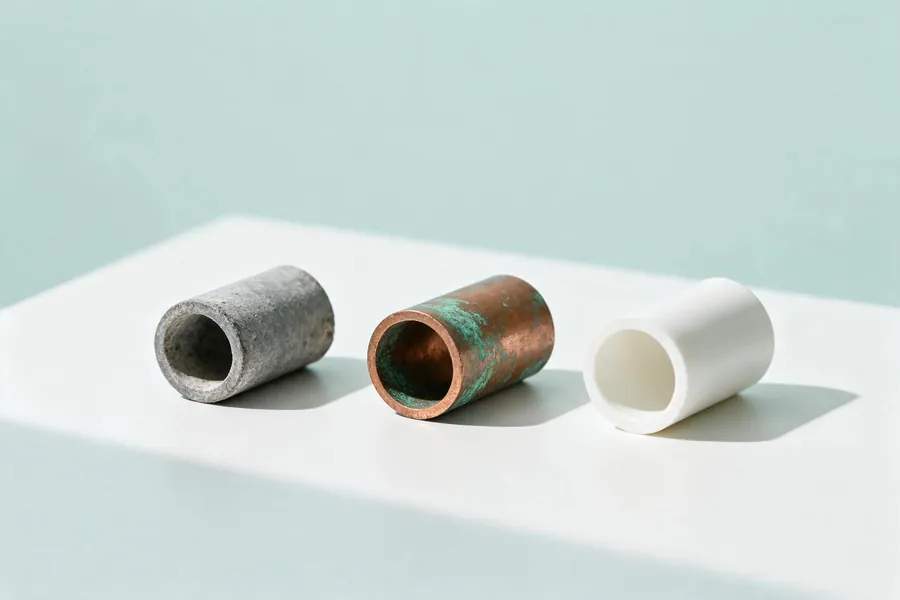
Houses built before 1973 may still have lead pipes, above all in northern Germany, Berlin and Saxony. Lead dissolves into standing water and is particularly dangerous for pregnant women, infants and small children. A limit of 10 micrograms per litre has applied since 2013, and since January 2026 lead pipes must have been removed or shut off. How to recognise them: grey, soft pipes with a dull shine that can be scratched with a knife. What to do is covered in the article Old pipes.
Exception 2: stagnation
Water that stands in the pipe for hours picks up metals from pipes and fittings and warms up, which helps germs. So after getting up, after a holiday and in rarely used bathrooms, let the tap run until the water is evenly cold, usually after 10 to 30 seconds. The water is not lost: use it for watering plants, rinsing and cleaning.
Exception 3: a private well
Around 700,000 households supply themselves from private wells. There is no supplier there to run tests. Nitrate from agriculture, germs from surface water and iron or manganese from the ground are typical problems. A lab test once a year is essential for your health, see Testing water at home.
What your supplier tells you
Every supplier publishes its analysis: hardness, nitrate, pH, minerals, often broken down by district. You will find the values for twelve German cities under Regions. If you have doubts about the plumbing in your house, have a sample analysed in a lab; tests for lead and copper start at 30 euros.
What speaks for tap water
- Price: 0.2 to 0.5 cents per litre, with mineral water costing a hundred times as much.
- Control: tested more often than any bottled water.
- Environmental footprint: roughly a thousand times better than bottled water, see Environmental footprint.
- No lugging crates, no bottle deposit, no microplastics from the bottle.
Try it out
Tap water checkEight questions about your home, pipes and region, an assessment with a traffic light and next steps.Hardness converterConvert °dH, °fH, °e, mmol/l and ppm into one another and read off the hardness range and descaling interval.Frequently asked questions
Is tap water the same everywhere in Germany?
No. The source (groundwater, reservoir, lake water, bank filtrate), the hardness and the minerals differ a great deal. All of it meets the same limit values, but it tastes different.
Can I use tap water for baby food?
Yes, if there are no lead pipes in the house and the water is freshly drawn. In the first months, boil it.
Why does my water taste of chlorine?
Some suppliers disinfect with small amounts of chlorine, especially in summer or after work on the network. It is harmless to health, and in an open jug it disappears within an hour.
Share