
A boil-water notice from your supplier, infant formula, travel and your own well: in which cases boiling is necessary, how long the water has to boil and what boiling cannot do.
In short
- Boiling kills bacteria, viruses and parasites, but it does not remove chemicals or metals.
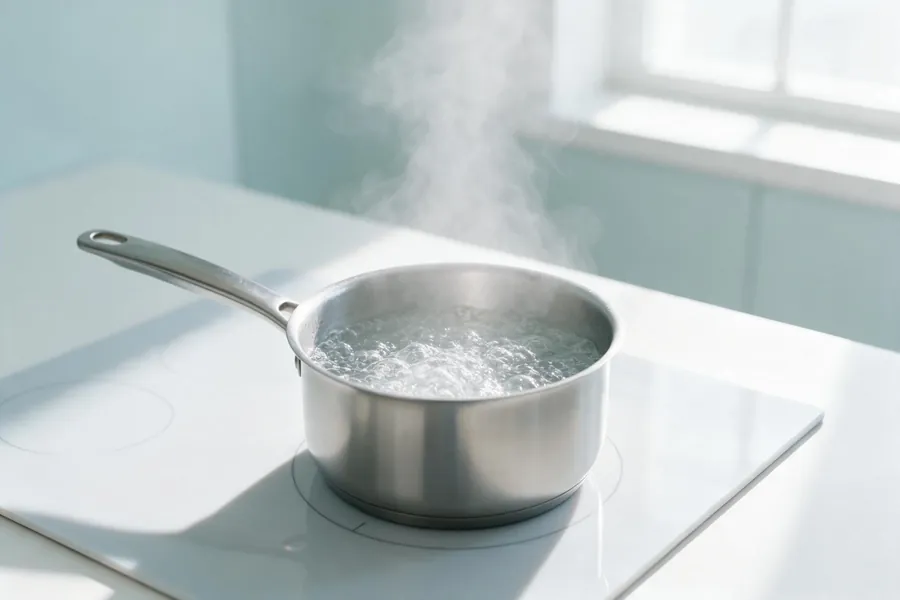
- Bring to a rolling boil, keep it boiling for three minutes, then let it cool.
- Under a boil-water notice it applies to drinking, brushing teeth, washing salad and ice cubes.
- For infants boil the water in the first months; from the age of complementary feeding, fresh tap water is fine.
What boiling can do
At 100 degrees, bacteria such as E. coli and Legionella, viruses such as norovirus and rotavirus and parasites such as Giardia die within minutes. What boiling cannot do is remove nitrate, lead, copper, pesticides, medicine residues or microplastics. On the contrary, as the water evaporates, dissolved substances become slightly more concentrated. So boiling is a remedy against germs, not against chemistry.
How to do it properly
- Put the water in a clean pan or kettle.
- Bring it to a rolling boil and keep it boiling for at least three minutes (kettles often switch off too early, in which case boil it twice).
- Let it cool, covered, in a clean container.
- Use it within 24 hours and keep it cool.
Above 2,000 metres, water boils at below 93 degrees, so boil it for five minutes there.
When the supplier issues a boil-water notice
This happens when germs are found in routine samples, after burst pipes, flooding, a power cut at the waterworks or work on the network. The notice then applies to everything that goes in your mouth: drinking, cooking with water that is not boiled anyway, brushing teeth, washing salad and fruit, ice cubes, baby food. Showering and washing your hands are fine, although people with weakened immune systems should be careful. The notice ends when two consecutive samples are clean, usually after a few days.
Infants
For the first six months it is recommended to boil the water for bottles, because the immune system is not yet mature. Draw tap water fresh (let it run until cold), boil it and cool it to 40 degrees. If you have lead pipes, or suspect them, use mineral water labelled “suitable for infant food” instead. From the age of complementary feeding, fresh tap water may go into the glass unboiled.
Travel
In countries where tap water is not drinkable, boil the water or buy bottled water with an intact seal. Avoid ice cubes, salad and cut fruit. Filters with UV or hollow fibre are a good addition for hikes. Which countries are affected is covered in the chapter Countries.
Your own well
If a germ sample is positive, boil the water until the cause (a leaking well head, surface water) has been fixed. In the long run a UV system makes more sense than boiling every day. What a well water test costs is covered in the article Testing water at home.
Frequently asked questions
Is a kettle enough for boiling?
It brings the water to the boil but switches off at once. To be safe, boil it twice in a row or use a pan.
Can I keep boiled water in the fridge?
Yes, in a clean, sealed container for up to 24 hours. After that, boil fresh water.
Share