
Water hardness is the amount of calcium and magnesium in the water. How it is measured, what the levels are, what it means for appliances, coffee, skin and detergent, and how to find your own value.
In short
- 1 °dH equals 10 mg of calcium oxide per litre or 0.178 mmol/l of alkaline earth ions.
- Soft: under 8.4 °dH, medium: 8.4 to 14, hard: over 14 (German detergents law).
- Hard water is healthy but annoying: limescale in appliances, more detergent, dull tea.
- Your supplier will tell you your value; the hardness converter turns it into all other units.
What hardness is
Water hardness describes the concentration of calcium and magnesium ions. They come from limestone, dolomite and gypsum that the water has seeped through. Groundwater from limestone regions is hard, while water from reservoirs in the low mountain ranges and from granite regions is soft. In Germany hardness is measured in degrees of German hardness (°dH), internationally in millimoles per litre, in France in °fH and in England in °e. 1 °dH corresponds to 17.8 mg/l CaCO3, so 14 °dH is about 250 mg/l. The Hardness converter translates between all of them.
The levels
| Hardness range | °dH | mmol/l | Typical for |
|---|---|---|---|
| soft | under 8.4 | under 1.5 | reservoirs, Harz, Ore Mountains, Black Forest, Lake Constance |
| medium | 8.4 to 14 | 1.5 to 2.5 | many mixed supplies, Hanover, Bremen, Stuttgart |
| hard | over 14 | over 2.5 | groundwater in northern Germany, Berlin, Munich, Cologne, Franconia |
Carbonate hardness and total hardness
Carbonate hardness (temporary hardness) is the part that is bound as hydrogen carbonate and precipitates as limescale when heated. Total hardness also includes sulphates and chlorides, which stay in the water. For limescale in appliances it is the carbonate hardness that counts, for taste and detergent the total hardness.
What hard water means
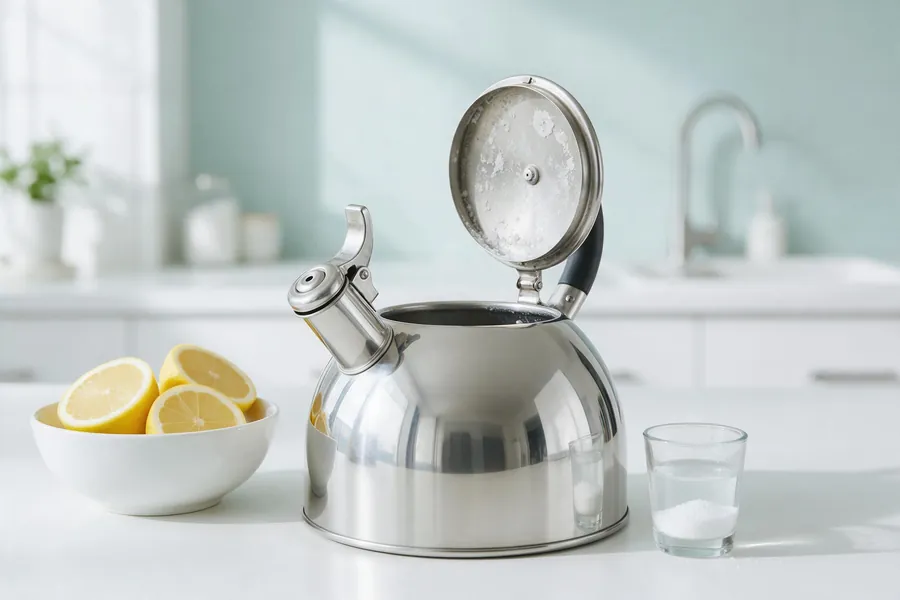
- Appliances: limescale in the kettle, coffee machine, washing machine and boiler. Descale regularly, see Removing limescale.
- Washing: more detergent is needed and laundry turns stiffer; a softener or correct dosing helps.
- Taste: hard water tastes fuller, sometimes chalky, tea turns cloudier and coffee more bitter.
- Skin and hair: lime soap dries them out, see Water and skin.
- Health: only benefits. Calcium and magnesium are minerals the body needs.
What soft water means
Hardly any limescale, little detergent, soft skin, clear tea. On the other hand, very soft water with a low pH can attack copper pipes, it tastes flat and it supplies no minerals. Coffee lovers like 4 to 8 °dH, and aquarists adjust the water to suit the species of fish.
Changing the hardness
Ion exchangers (countertop filters, water softeners) swap calcium for sodium, while reverse osmosis removes both. Whole-house water softeners are worth it from about 14 °dH and cost 800 to 2,000 euros plus salt. For drinking water, one untreated tap should remain. How hard your water is can be seen for twelve cities under Regions.
Frequently asked questions
How do I find out the hardness at my address?
On your water supplier’s website, often with a postcode search. Alternatively on your water bill, from the local health authority or with a test strip from a chemist’s or drugstore.
Is softened water still healthy?
Yes, it contains a little more sodium and less calcium. For people on a low-salt diet and for baby food, it is better to use the untreated tap.
Share